
Unbelievably, I have been attempting to write this essay for nearly four years. I have now cut it up into 2+ different posts for readability. This first post is a commentary on the current condition of the world, especially the destruction wrought by those who claim to love their countries. The further posts will be broader reviews of the subject matter of this essay. Stay tuned.
Patriotism is the feeling of love, devotion, and a sense of attachment to one’s country or state. – Wikipedia
Ultimately derived from Greek patrios, meaning “of one’s father,” [family] Merriam Webster
We have been assailed in recent years by the loud voices and actions of those who claim to be acting out of a deep and abiding love for their countries. This “love” seems to have been focused on attacking the [mostly but not only] racialised other as a deep threat to the country’s economy, security, culture and ultimately homogeneity. The actions that have followed have been punitive psychologically and physically, often with no upside for anyone but a few already privileged people. It is very difficult to write anything about this which can do any more than point out the hypocrisy and wrongness of it all. A sentence or two would suffice. Love for country that is exhibited mainly by vitriol provides its own incontrovertible evidence for why you should not agree with it. An illegitimate and bad-faith position will not be convinced by an appeal to reason. It neither wants nor seeks it. Similarly, a good faith position needs no convincing that humanity is inherently precious. As such, here I use the lens of a Turkish soap, not to convince but to reflect in a cathartic way on where we have always stood in relation to the question. What does it mean to love your country?
In 2021, by sheer happenstance, I stumbled across a sweeping Turkish soap-saga called Vatanım Sensin. I do love Turkish film and TV—so more recommendations are welcome. (I once spent a year boring students with praise for Midnight at the Pera Palace.) Non-Anglosphere storytelling has its own energy and tropes that allow us to peek into other worldviews – Turkish programming is no different in this guise. This is not a review as such. It is a contemplation on the relationship between love and revolution and the love of country, a sort of metaphor or lens if you like. To provide a means of contemplation on the place of love in our relation to our countries. Who or what do we love when we say we love our countries?
Let’s Start with a Short-ish Summary of the Plot of VS
It is very difficult to classify Vatanım Sensin’s genre. It has elements of history, war, romance, and drama—some of my favourite things. Azize and Cevdet are essentially the co-leads. The very beginning of the series opens in 1912. Cevdet [Halit Ergenç] is a soldier in the Ottoman army based in Selânik [now Thessaloniki]. The Greek invasion that year is aided by Ottoman army soldiers, including his childhood friend, the backstabbing, wife-coveting, expletive, expletive, expletive Tevfik [Onur Saylak]. In the first episode, Tevfik shoots Cevdet in the back and leaves him for dead. He is hoping to make a move on his friend’s wife [Azize – Bergüzar Korel] once she gets over the death of her husband. Azize very stubbornly refuses to be consoled by the passage of time and Tevfik’s promises of care and largesse. Presumed dead, Cevdet returns to Türkiye and İzmir (Smyrna) as a colonel in the Greek army, though he is actually an undercover agent for the Turkish resistance. Cevdet’s character is based on the real-life Mustafa Mümin Aksoy—who, though not as high-ranking a soldier as Cevdet, worked undercover within the Greek occupation forces.
Azize and Cevdet have three children. The eldest is their adopted son, Ali Kemal [approximately 20 years old], a bit of a maverick with an unstable temper; he really comes into his own when he starts making some money, acquires a hero coat, and joins the resistance against Greek occupation. The youngest is Hilal [approximately 16 years]. She is a firecracker and militant freedom-wanter. She often has more courage than sense and gets into trouble quite frequently as she tries to almost single-handedly push back the Greek invaders. Unbeknownst to anyone [at least initially], she also has a secret identity—Halit Ikbal, the fiery revolutionary essayist. Yildiz [approximately 18 years old] exudes big middle child energy. She absolutely loves the soft life and will do anything to get more of this elusive life that she glimpses over the walls and in the ballrooms of the invaders’ buildings. Her plan for entry into this life is named “Leon”. Leonidas Papadopoulos is the son of the commander of the invasion (Vasili-I-really-should-have-gone-to-therapy-instead-I-became-a-soldier) as well as a lieutenant with the invading force. He is initially notionally onboard with Yildiz’s plan and even tells his mother, Veronika [a woman hiding a whole heap of trauma behind a really haughty façade], that he wants to marry Yildiz. That is until he gets to know Hilal. He falls headlong, irrevocably, almost dangerously in love with her, risking his life, his family, his country, and his principles. The two of them are a perfect match despite the obvious obstacles. Leon has the heart of a poet and is masquerading as a soldier. Hilal has the heart of a warrior but masquerades as a writer.
This essay is mostly a spoiler-free zone from here on. If you get to watch it, it is a wild ride of 2 seasons and 59 episodes. Against the backdrop of the war and its settled history, the series explores how these characters navigate not just the war but also their desires, interests, and hopes in the face of it.
But What Use is Love in the Face of National Crises?

“every man has a map in his heart of his own country and that the heart will never allow you to forget this map.”
―
Themes of love and devotion to country and family are overwhelmingly present in VS. Overall, Leon’s character, as scripted, is driven by two main guiding principles—his love for his country and [eventually] his love for Hilal. In season one, there is a tension within and between those principles. He doesn’t really know how to love his country, other than joining the Greek army as a misguided way to seek his father’s approval. He also does not want to love Hilal, as this feels like betrayal. He doesn’t believe that he can love his country and Hilal at the same time. That is the source of his character’s conflict in season one. In season two, this conflict dissipates almost completely. He joins the Bolsheviks, not to please Hilal but out of love for his country because he believes the occupation is inherently damaging. Can you love a country without loving all its people? Or even all people? For what is ‘country’ without people?
you took a handful of land and called it a country. -Azize
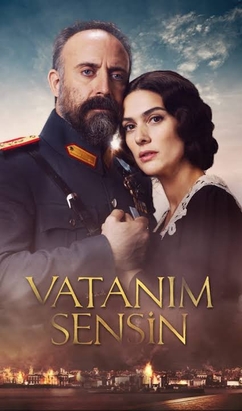
Cevdet and Azize are portrayed by married-to-each-other IRL actors Halit Ergenç and Bergüzar Korel. Ultimately and ironically, Azize and Cevdet are better parents to Leon than Vasili and Veronika. For both Cevdet and Azize, character tension arises from the both of them trying to balance the love they have for each other with the love they have for their family and their country. They navigate these tensions in really beautiful ways, and this navigation is essentially the backbone of the story. Their love for each other and their family gives substance to the love they have for their country in what they are willing to give up for that love.
Ultimately, without more, a flag is just a piece of cloth, a country a patch of ground.
So, What Should it Mean to Love a Country?
When Azize thinks that Cevdet is dead, she mourns him by wondering why he would die for a piece of cloth, a patch of ground. In many ways the substance of that question is a running motif through the series. Why did he risk his life for his love of his country? What does it mean to love a country? The answers given by VS can be found in one of the most quoted lines of the series, which comes from the exchange between Leon and Hilal, some of which I have reproduced below:
Leon: Barbarians!… are due to here today. Why isn’t anything happening in the senate? Why do the senators sit there without legislating? Because the barbarians are coming today. Once the barbarians are here, they’ll do the legislating.
Hilal: I know this poem. It’s Cavafy’s “Waiting for The Barbarians”.
Leon: Then you surely know the end. The barbarians don’t come. And the people are disappointed. They return to their homes crestfallen. Regardless of their fear in fact waiting for the barbarians is what holds them together.
Hilal: Nonsense! What’s that supposed to mean?
Leon: Enemy… You became a nation that cannot stand together without an enemy. You don’t love each other actually. You have no dreams no goals. You don’t produce anything. Only the existence of an enemy reminds you of who you are. For example that Halit Ikbal, his pen works only when he has something hateful to say to the enemy.
Hilal: It isn’t like that!
Leon: Isn’t it? When was the last time we heard something beautiful from him? Like portraying a tree. I don’t remember. When was the last time he mentioned love in his writing?
Hilal: Love?
Leon: Love!
Hilal: While the country is in this state?
Leon: Yes Miss! A heart without love is a barren land. Nothing flourishes there. How can you love a country, if you cannot love another person?
The lines that stand out here are:
“You became a nation that cannot stand together without an enemy. You don’t love each other actually. You have no dreams no goals. You don’t produce anything. Only the existence of an enemy reminds you of who you are….How can you love a country, if you cannot love another person?” – Leon
And when there are no enemies, enemies are manufactured, because this is a love that requires hate. Which is no love at all.
How can you love a country if you cannot love another person?
What is true love for a country then? Cevdet and Azize tell each other till the very end, “You are my homeland.” This is what the title “Vatanım Sensin” literally translates into. Leon’s admonition to Hilal above inadvertently builds on and responds to that: “A country without love is a barren land; nothing grows there… How can you love a country [homeland] without loving a person?”
It is ridiculous to claim to love our country/countries/this earth without loving all those it contains. Love that stops at borders is no love at all. It is ridiculous to love pieces of cloth and patches of land more than the living beings that these items are containers and signifiers for. It means that we have not yet learnt to love the world. That we have not learnt to love each other or even ourselves. Being the best person for each other does not mean agreeing with everything other people say or do. Love also means critiquing rigorously the actions and words of our fellow earth dwellers. This earth is our homeland. Loving it means loving it and all life in it. Doing life together. Not creating divisions based on which piece of cloth happens to wave above the patch of earth we just happened to enter the world through.
The truth is activism – when done right – isn’t a symptom of having too much time on your hands, being a killjoy, or manufacturing problems that don’t exist. It’s love actualised. Shane Thomas
“Never forget that justice is what love looks like in public.” Cornel West
When Saidiya Hartman asks, ‘Is abolition a synonym for love?’ (2020: webpage), I believe she is inviting those who want to build a world of flourishing futures to love the one we have now, and those that live on it, and everything in it, so that we are willing to risk our comfort today, that the world may survive tomorrow. And so we abolish anything and everything that is harmful to those we love. Going back to my thoughts at the start of my essay, I think that there are different types of people who we can be in conversation with or refuse to engage with. People who have the word “love” in their mouths all the time, but none in their hearts. People who standby and do nothing, hoping for change to happen through others. And those who are impelled by love, put their bodies on the gears of the odious machine.
Mario Savio – Bodies on the Gears
What Type of Love Makes People Put Their Bodies on the Gears?
Love without action feels pretty pointless. But what does love make us do? ‘Love’ is such an active word that I think sometimes loses its depth in English. The Igbo word for love, “Ifunanya”, means “I see you”. I. See. You. What do you see when you look at fellow humans? What do we do with a structure of knowledge that cannot see many of the bodies, spaces, and times it governs? Maybe revolution is the only love that matters. Let us be each other’s homeland. Let us see each other. If you are reading this. I see you.
If you have watched or are able to watch Vatanım Sensin, I would like to know what you think. But more than that, I want to live in a world where people love deeply and profoundly. Where we see each other.
“If you’re here because you hate the oppressor and you don’t have a deep love for the people then you are a flawed revolutionary.” – Afeni Shakur to Jamal Joseph in Panther Baby


