
This is a rejoinder/addition to an old post that I wrote a couple of years ago. I revisited that old post when I realised that it was the 10th anniversary of the debate that served as the inception of World Afro Day in 2017. World Afro Day is celebrated annually on 15 September. It is a global day dedicated to celebrating Afro hair and raising awareness of its significance for culture, identity, and self-expression. Founded in 2017 by Michelle De Leon, World Afro Day seeks to challenge stereotypes, promote inclusion, and help end discrimination based on natural Afro-textured hair. Since then, World Afro Day has become an international movement that encourages education, empowerment, and greater understanding of the cultural and social importance of Afro hair.
Also about 10 years ago, I finally gave in to the Big Chop. The Big Chop is a cornerstone of the natural hair movement. It is the decisive move in the transition from chemically treated hair back to natural hair. You chop off all the chemically treated hair and leave your natural hair to grow. “But what is all the fuss about?” you may ask. “It is just hair,” you say. For anyone who has never experienced pouring burning acid on your hair to straighten it, it may just be hair.
‘Is your hair still political?
Tell me
when it starts to burn.‘
Audre Lorde
Why is Black hair political?
So ten years ago, when I chopped off all my chemically treated hair, I did it for personal reasons, but also recognised that it was a political act. Black hair is often not considered “professional“. Natural Black hair has been banned from workplaces and schools. But it is the microagressions that dominate. Unwanted hair touching. Derogatory and ignorant comments. Looks. Hair products and hair care that are impossible to source. Ignorance. All these have led Black women to mutilate and thus erase a distinctive part of their identity – their hair. This has meant that Black women would put extremely harmful chemicals in their hair to straighten it. Or buy expensive weaves of dubious provenance to cover their own curls. Or subject themselves to blazing iron rods that remove curls from tresses.

I see the foregoing as a form of epistemic violence. The dominant epistemology/received “knowledge” that Black hair is unprofessional results in repeated acts of self-harm. The voluntariness for which is at best doubtful. Epistemic violence is the cognitive inability or refusal to engage with the truth of another group’s social experience. Any measure that restricts Black women’s freedom to treat her hair as she wishes may be said to be a form of epistemic violence. This means that for a Black woman, the freedom to wear natural hair is an intellectual issue as well as a matter of personal aesthetic choice. The epistemic world only recognises certain bodies as normative and creates policies around those normativised bodies. Refusal to acknowledge the condition of the Black woman’s hair as natural and thus normative, is a refusal to see the Black woman as natural. In fact, as has been seen in some South African schools, merely wearing the hair one is born with is a sign of protest. To exist is to resist. Existence is resistance.
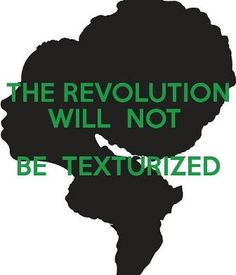
When existence itself becomes protest, the personal is already politicised. When the lines between the personal and political are persistently blurred, personal decisions are always fraught with political cogitations. For example: As a postcolonial decolonial pan-African feminist (yes, that is a thing…) do I not owe a scholarly duty to be an adherent of the natural hair movement? (In essence, to practise what I preach) As an autonomous person, do I not have the freedom of choice to do what I want with my hair? Natural or Textured? But how free is my choice when the structures of society implicitly support one choice over the other? Black hair is still political. But remember, freedom like a skylark flies upward. Black hair grows straight up.

A luta continua; vitória é certa.
For hair. For here. For her.

Ohio School Apologizes After Attempting To Ban ‘Afro-Puffs’ And ‘Twisted Braids’
Racism row over South Africa school’s alleged hair policy
Until recently this school in South Africa told black girls to chemically straighten their hair
‘Wear a weave at work – your afro hair is unprofessional’
Chakravorty, Spivak Gayatri, Nelson Cary, and Grossberg Lawrence. “Can the subaltern speak?.” Marxism and the Interpretation of Culture 271 (1988): 271-313.


